Amid the growing attraction to matcha and tea, a unique space in the heart of Issaquah awaits tea enthusiasts of all kinds, offering a one-of-a-kind experience on the complexity of tea-making. Right off of Front Street in the 195 building is Experience Tea Studio which has operated as a business in Issaquah since 2011. Run by Certified Tea Specialist Roberta Fuhr, Experience Tea Studio offers all sorts of classes, ranging from history, discovery, blending, etiquette and even a unique tea and chocolate pairing class. Without a doubt, you will leave with a deeper appreciation for the rich history, intricate process, and vibrant culture of tea.
As soon as you walk into the studio you are invited in by the warmth and variety of the space, the air is filled with a subtle aroma of dried herbs and spices, creating an immediate sense of calm and curiosity. The walls are filled with an assortment of different tea leaves, each carefully displayed in jars. As I took in the small cozy space, my eyes immediately caught on to the remains of the matcha ceremonial class that Roberta had just finished.
Roberta has a way of making the history of matcha and green tea come to life, and one of her specialities is sharing the fascinating origins of matcha. What many people do not realize is that matcha actually has its roots in China. Roberta explains how, “The Chinese were doing tea in this style, where they would pulverize the tea leaf, press it into a hard shape and then when they were going to make tea, they would chip it out and put it in a bowl and whisk it with water and drink it.” She goes on to add that, “When the Buddhist monks from Japan experienced this when they came to visit, they took tea seeds back to Japan and it grew in monasteries and other areas. They cultivated it. And as time went by there was a lot of warring that went on in Japan, but with the Shogun and the samurai and all they also wanted to elevate their status in society…which was done through practicing tea ceremony. Most shoguns had their own tea master, and so the tea ceremony evolved.” Over time, the style of matcha also evolved, and by the 15th century matcha was refined into the sweeter, more delicate form we enjoy today. Roberta painted this picture beautifully, bringing her travels in Japan to life with photos of the lush green fields where matcha is grown.
One part of the tea-experience that makes it special is how Roberta travels in-person to different countries such as Japan to prepare and garner knowledge to teach her classes. Within the photos Roberta emphasized the shaded area of leaves that workers would cover with black fabric, she states that by doing this when there is new growth, “it stresses the plant, and it tries to reach up for light. This produces a different ratio of compounds, and produces more chlorophyll and more caffeine, because the bush is stressed, and it also inhibits theanine from changing into polyphenols, which can be very bitter.” This is how ceremonial grade matcha is developed and why it should be a vibrant deep green.
One common misconception people have is that all matcha is the same, however in actuality there is a complex process in grading matcha how the tea plant is grown and processed. Roberta explains how ceremonial-grade matcha is carefully stone-ground, a slow process that helps preserve the delicate flavors. The difference between your expensive ceremonial grade matcha in beautiful tins compared to food grade that you find in your everyday grocery store shelves lies whether or not the tea plant has been shade-grown and how carefully the leaves have been processed and ground. The process behind what differentiates food grade and ceremonial adds a deep layer of understanding when it comes to the craftsmanship involved in creating these distinct grades. Recognizing these subtle differences and the work that goes into creating the ceremonial matcha I use everyday makes each cup feel more meaningful knowing that each sip is connected to people who have perfected this craft for centuries.
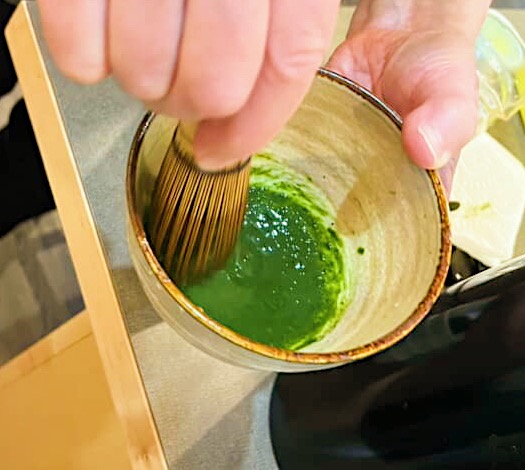
Caption: Roberta whisks the matcha to life
The true magic of the studio, however, comes in the experience of drinking the tea. While demonstrating the traditional method of preparing ceremonial matcha, she emphasized that you should never put boiling water in, as it can degrade the taste of matcha. Amidst the intricate smoothing and mixing process, and the fast-paced whisks, Roberta shared a fascinating story about the bamboo whisk: “I watched a guy carve this, and we had to weave these threads in between,” attesting to the complicated art and skill that encapsulates every step of the tea-making process.
The initial taste of Roberta’s matcha was somehow new, with an explosion of flavor that felt fresh and vibrant. “It should, it should taste a little sweet to you,” Roberta noted, and sure enough the flavor had a subtle sweetness. “That is the result of shade growing,” she continued. “It increases theanine levels, as the process inhibits its transformation into polyphenols. That is why it’s rich in flavor.” She explained further, “You are drinking the whole plant or the whole leaf, which enhances the taste, but it shouldn’t be overpowering or obnoxious.” Roberta shared that while not every ceremonial matcha is quite like this, it is common for high-quality matcha, like hers, to have that refined and balanced flavor.
Discovering the history behind my daily morning drink and a beloved drink for many was eye-opening in so many ways. Often in our busy lives we do not stop to think about where something we enjoy came from and even the illustrious and persisting history behind it. At Experience Tea this was something that Roberta helped me to appreciate.
Stepping into Roberta’s tea studio was quite unlike something you experience everyday.
Though we only saw a glimpse into part of the learning that Roberta offers, it was clear that the experience was beyond the simple mechanics of tea-making. It is about connecting with the craft, learning about your own taste preferences, and discovering something new. In a world where trends like matcha often dominate, Roberta’s approach is both refreshing and grounding. “Tea Education is overwhelming,” she admits. “That’s why I teach, because it empowers people.”
At Experience Tea Studio, Roberta has created a unique and special space offering everything from hands-on classes to international tea tours, all designed to help you explore the world of tea. Her passion for both tea and teaching shines through, as she blends education with her business seamlessly. If you are in Issaquah and looking for a deeper dive into tea, a class here is the perfect way to start your journey into this rich and complex world.